
MA DOC Massachusetts Prison Role
The Massachusetts Department of Correction is the statewide prison agency. Official publications use the abbreviation MA DOC, although the agency also uses DOC. It operates the state correctional system and keeps state-prison sentence, custody, movement, and release records. The current official locations directory lists thirteen institutions. County sheriffs remain separate custodians for jails and houses of correction.
That split controls every search. A person held on a county matter may never enter MA DOC. Someone can also leave a sheriff for MA DOC, another sheriff, BOP, or ICE. In those cases, the local agency's release entry describes the end of local custody, not freedom from all custody. The MA DOC offender search answers only the state-prison slice, and even that official public route is framed around people now housed in a Massachusetts prison.
The MA DOC agency page identifies the state authority and its correctional role.
This is the proper agency for state-prison records, while county custody must be traced to the sheriff or police office that held the person.
Use the MA DOC Offender Search
Massachusetts titles its official lookup “Find someone housed in a Massachusetts prison.” The instructions route to VINELink and say it can locate someone being held in an MA DOC facility. Search by full first and last name or by commitment number. Select Massachusetts, compare possible matches, and read only the custody and facility information the result actually shows.
- Open the official Massachusetts housed-person instructions and follow the route to VINELink.
- Select Massachusetts and enter the exact full first and last name, or use the commitment number.
- Compare possible matches carefully. A similar name is not enough to establish identity.
- Record the query, identifiers, result details, and time of the check.
- If no record appears, try only supported spelling or identifier corrections, then move to records and other custodians.
The state lists 866-277-7477 for telephone lookup or VINE help. Only MA DOC participates in the Massachusetts VINE program. A Berkshire, Bristol, Suffolk, Worcester, or other county jail record should not be expected merely because the portal has a statewide interface.
The official MA DOC search instructions state this housed-person scope and the accepted identifiers.
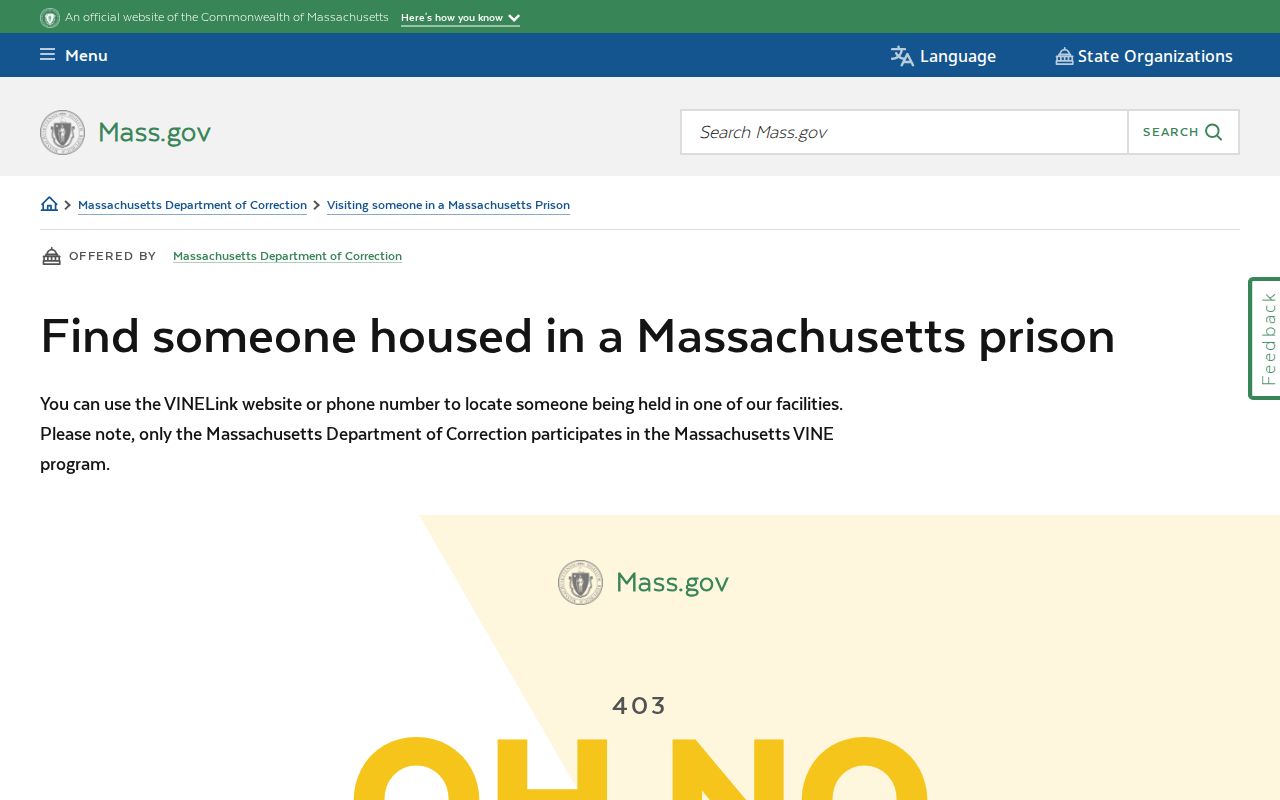
The wording shown in the source supports a current-custody check, not a promise that a discharged profile remains public.
MA DOC Released Search Limits
Massachusetts does not document a conventional historical offender database that guarantees a persistent profile after release. No official source reviewed identifies post-release status wording, a public historical release-date field, a released-profile retention period, or a projected date shown through VINELink. No released-person result was available to validate such fields. Therefore, a page must not claim that VINELink displays “Released,” “Discharged,” a release date, or continued supervision for an MA DOC case.
Important: A missing MA DOC result is not proof of release, discharge, sentence completion, or freedom from another agency's custody.
An unsuccessful lookup has several possible causes. The person may have been released, transferred, moved to county, federal, immigration, or out-of-state custody, entered under a different spelling, or failed to match the supplied identifier. The event also may fall outside the public service's scope. For an old MA DOC release, request the source record and check parole or the sentencing court when those routes fit.
MA DOC Release Records to Request
The public locator has a narrow role, but MA DOC keeps records used to compute and process state sentences. A focused request should identify an existing document. Avoid asking the agency to create a new narrative or data set. Supply enough detail to locate the custody period, then ask for the field or source record that answers the question.
| Record or field | Question it may answer |
|---|---|
| Commitment number | Which MA DOC file belongs to the person |
| Custody movement history | Which facilities or agencies held the person and when |
| Release order | What authority supported the planned departure |
| Release-type entry | Whether the event was parole, expiration, court action, or a transfer |
| Destination or receiving agency | Whether custody continued under another authority |
| Sentence-computation sheet | How relevant legal dates and deductions were applied |
| Certificate of discharge | Whether the document confirms the sentence-ending event it records |
The official data system uses terms such as Earliest Release Date, Earliest Release Max Date, sentence expiration, and projected discharge date. Those internal or defined dates answer different questions. None was established as a public VINELink field. The actual physical departure may also differ from a computed date because a warrant, another sentence, parole processing, transfer, or other legal action intervenes.
The MA DOC glossary defines the agency's sentence and release terms.
The official definitions help frame a precise records request without turning an internal date into a public release promise.
MA DOC Release Categories Differ
MA DOC reporting uses “release” more broadly than everyday speech. Release to parole supervision is a community departure with Board supervision. Release without supervision includes discharge, sentence expiration, fine payment or expiration, and good-conduct discharge without parole or probation. Release with supervision covers a discharge or expiration while probation continues. A person under both parole and probation is grouped with parole-supervision releases.
Other categories do not establish community departure. Release to another criminal justice agency can mean federal or immigration custody, an out-of-state sentence, a warrant, a house-of-correction term, or another DOC sentence. “Remain Incarcerated” may record a legal-status change within the same agency. A transfer is a custodial handoff. A court release may reflect a revoked, stayed, or vacated sentence or a court-related event. The type and destination must travel with the date.
| MA DOC category | Community freedom established? | Next check |
|---|---|---|
| Parole supervision | Community departure from that custodian, with Board jurisdiction | Parole permit, supervision, and later termination record |
| Without supervision | May show discharge to the community | Release entry and discharge certificate |
| With probation | DOC custody may end while court supervision remains | Sentencing court and probation department |
| Another justice agency | No | Receiving agency record or locator |
| Remain incarcerated | No | MA DOC legal-status and movement record |
The Admissions and Releases Types page is the official source for this taxonomy.
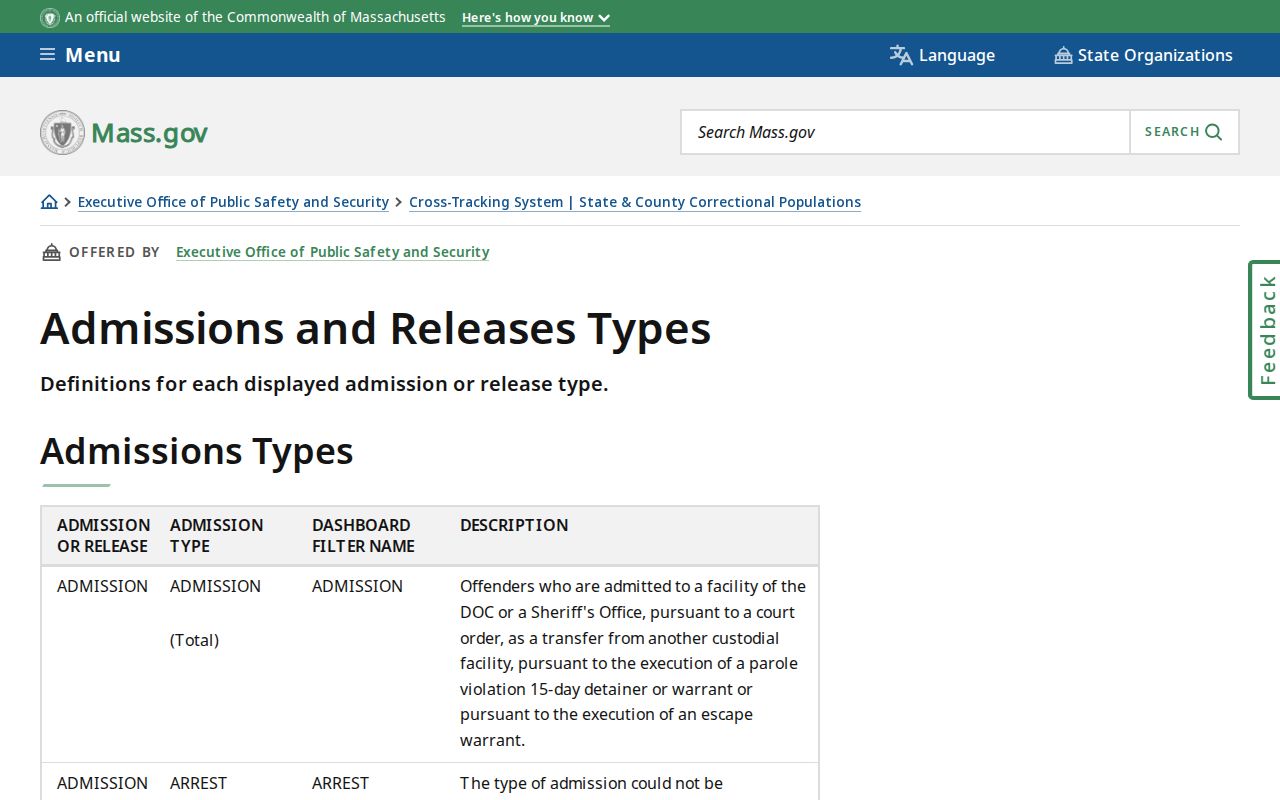
Its distinctions show why a statistical release entry must not be reduced to a bare date.
MA DOC Discharge and Parole
Parole is conditional community release, not automatic sentence termination. Under M.G.L. c. 127, § 130, the Parole Board applies the statutory release judgment and conditions. Board jurisdiction generally continues until the sentence maximum, as adjusted under applicable law, unless an earlier certificate terminates it.
Expiration or good-conduct discharge can end DOC custody without parole. Sections 129C and 129D require a certificate of discharge when qualifying deductions establish the reduced maximum date. Probation can still begin or continue because it is court supervision. Conversely, release to another authority ends a DOC status while physical custody continues.
The Parole Board's Transitional Services Unit schedules institutional release hearings, calculates parole eligibility and discharge dates, executes release permits, and coordinates transitions. Possible destinations include community supervision, out-of-state supervision, another state or federal sentence, ICE custody, or another correctional placement. A favorable decision is not the actual departure date. Plan verification and permit issuance come first.
- Parole
- Conditional release to the community under Parole Board jurisdiction.
- Probation
- Court supervision that is separate from MA DOC and parole.
- Discharge
- The end of the sentence or DOC jurisdiction recorded by the relevant source.
- Release permit
- The Board document used to carry out an approved parole release.
MA DOC Release Date Computation
MA DOC's Central Date Computation Unit constructs sentences and calculates release dates. Under 103 CMR 411, an institutional records supervisor submits a projected discharge date with applicable deductions before the expected event. Under 103 CMR 410, a release order and later accuracy review support the process. These are internal records steps, not public VINELink fields.
Massachusetts law permits earned deductions for qualifying activity and program participation under § 129D. The limits differ by state-prison and house-of-correction sentences, and completion credits have separate caps and rules. The DOC glossary also states that statutory good time was eliminated for offenses committed after June 30, 1994. Older offense dates and current earned credits therefore cannot be placed into one sound public calculator.
Offense date, mandatory terms, concurrent or consecutive sentence structure, jail credit, forfeiture or restoration, parole rules, and another case can all affect the result. The most useful documents are the computation sheet, release order, certificate, and movement or release entry. An April 2026 MA DOC announcement described an internal tablet planning tool that lets incarcerated people see anticipated timing. It did not create a public projected-date search.
Note: A projected date guides internal work, while the actual release record documents what occurred and where custody went next.
MA DOC Release Supervision Trend
The 2024 MA DOC trend report counted 1,223 releases. It recorded 442 to parole only, 248 to probation only, 339 to both parole and probation, and 194 without either. Thus 1,029, or 84%, had some supervision. In 2020, the report counted 1,925 releases and a 74% supervised share. The release total fell while the share routed to supervision rose.
These are dated jurisdiction events under the report's definitions. They are not a list of names, and they should not be read as unique people returning to the community. The releases dashboard and releases-to-community dashboard also cover different populations, so the source and period must accompany any comparison.
The MA DOC Releases to Community dashboard supplies an official view focused on community events.
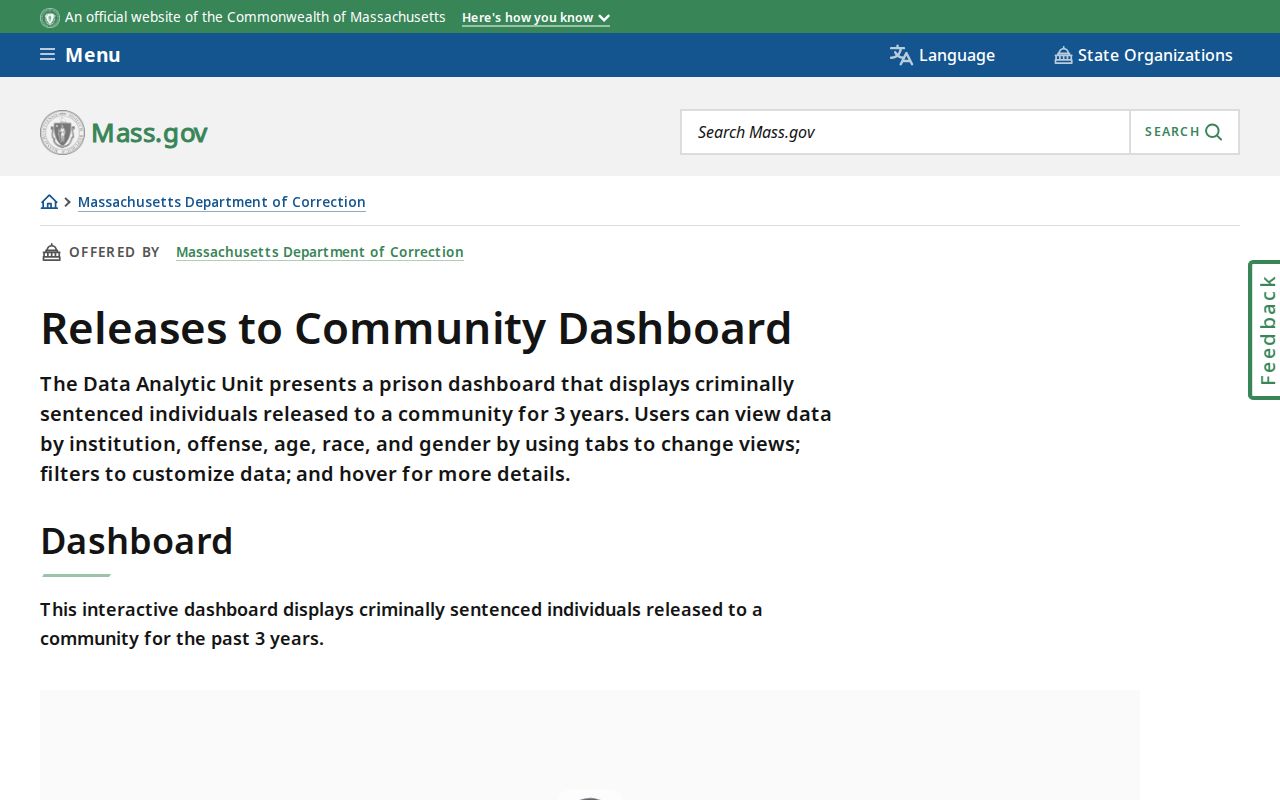
This dashboard adds statewide context, but it does not confirm one person's identity, custody history, or discharge.
MA DOC Dated Release Context
Another MA DOC report gives a different but useful slice. Prison Population Trends 2023 counted 1,557 criminally sentenced jurisdiction releases. It classified 730, or 47%, as parole to the community or release from a parole detainer. Another 495, or 32%, were expiration to the community. The report placed 233, or 15%, in parole or expiration to another authority. Smaller categories covered other jurisdictions, court or crime-lab events, and other releases.
The fourth-quarter 2024 admissions and releases report counted 943 releases across criminal, civil-commitment, and pretrial populations during that quarter. It recorded 400 criminal, 421 civil-commitment, and 122 pretrial releases. Overall releases were 0.7% below the prior quarter, while criminal releases were unchanged. The report cautions that pandemic-era shifts beginning in March 2020 complicate long comparisons.
These figures use distinct populations and time windows. They cannot be merged into a person-level search or treated as a count of people who entered the community. The 2023 jurisdiction report includes transfers to another authority, and the quarterly total includes more than criminally sentenced releases. Source title, date, population, category, and destination are all needed for a sound comparison.
MA DOC Versus County Release
The correct source follows the custodian. MA DOC controls state-prison records. A county sheriff controls its jail and house-of-correction records, including many pretrial, bail, time-served, and county-sentence events. Police control short municipal lockup records. Neither the location of a state prison nor a statewide portal moves those records to the local sheriff.
| Issue | MA DOC prison | County jail or HOC |
|---|---|---|
| Custodian | Massachusetts Department of Correction | Relevant sheriff |
| Public live route | Housed-person instructions through VINELink | Varies by county |
| Past event | DOC release, movement, computation, or discharge record | Sheriff booking, movement, or release record |
| Transfer risk | Federal, immigration, out-of-state, sheriff, or other DOC status | MA DOC, another sheriff, warrant agency, BOP, or ICE |
The County Directory routes a local custody event to its locality site. Confirm the named office before filing. MA DOC expressly says it does not process county-jail or house-of-correction public-record requests.
Request MA DOC Release Records
Use the MA DOC online public-records route, email doc.rao@state.ma.us, or mail the Primary RAO, Department of Correction, 50 Maple Street, Milford, MA 01757. The official page identifies Kate Silvia and 508-422-3436. Telephone acceptance is discretionary. It says the first four hours of response work are free and later work may be charged up to $25 per hour.
- Give the full name, aliases, commitment number, known institution, and a narrow custody or release range.
- Ask for a specific existing record, such as the release order, release-type entry, destination, computation sheet, certificate, or movement history.
- State the preferred electronic format and ask for segregable nonexempt portions if redaction is required.
- Review any fee estimate and narrow the scope before work proceeds when that would still answer the question.
- Use the sheriff, court clerk, Parole Board, BOP, or ICE when that office holds the requested record.
Under M.G.L. c. 66, § 10, a records access officer ordinarily must produce, permit inspection, or explain withholding within ten business days, subject to lawful fees and extensions. M.G.L. c. 4, § 7, clause 26 defines public records and exemptions. CORI limits, privacy or medical facts, investigations, victim data, and correctional security may affect disclosure. An agency need not create a record it does not keep.
Court records follow a separate judicial access route. Use MassCourts and the clerk for the official docket or order rather than asking MA DOC to supply the court file. If parole was involved, a public life-sentence decision may help in the limited cases that collection covers, while personal parole records may require authorization. Each request should stay with the office that created or maintains the record.
The official MA DOC records page provides the current submission routes and fee terms.
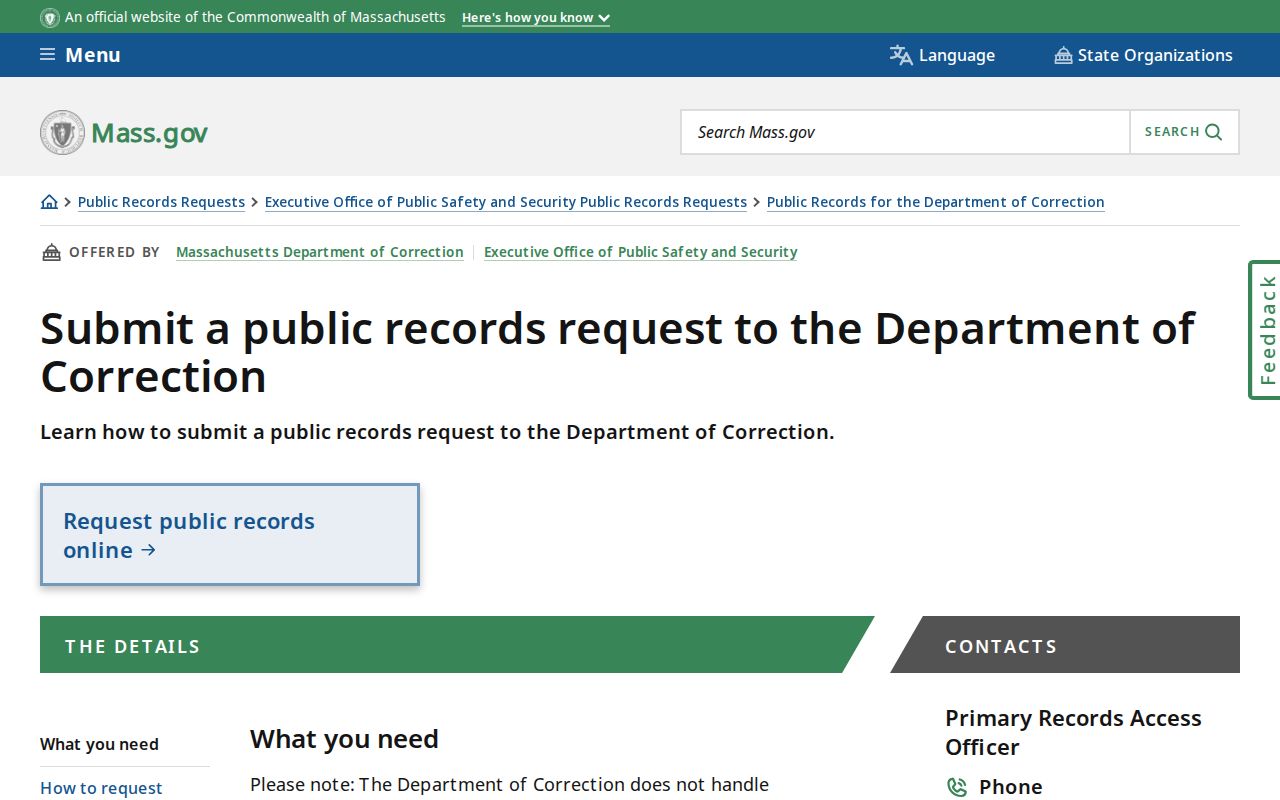
A precise request is the strongest route when the public MA DOC offender search cannot resolve a past release or discharge.