
Massachusetts Release Records Explained
A release entry answers one agency's custody question. It may show that a sheriff released someone on bail, that a sentence expired, that MA DOC released a person to parole, or that one agency handed the person to another. The word does not always mean a return to the community. MA DOC even counts some changes of legal status while a person remains incarcerated as releases for reporting purposes. The release type and destination matter as much as the date.
Massachusetts has several custody layers. Municipal police hold some people for a short time. Sheriffs run jails and houses of correction. The Massachusetts Department of Correction holds state prisoners. The Federal Bureau of Prisons runs FMC Devens, and ICE may hold a person under immigration authority. Each custodian creates and controls its own records. A county roster is a live list, so a person often vanishes after departure. The old booking, movement, court, or release record must then be requested from the office that made it.
The official Massachusetts Department of Correction overview shows the state agency whose records apply to state-prison custody.
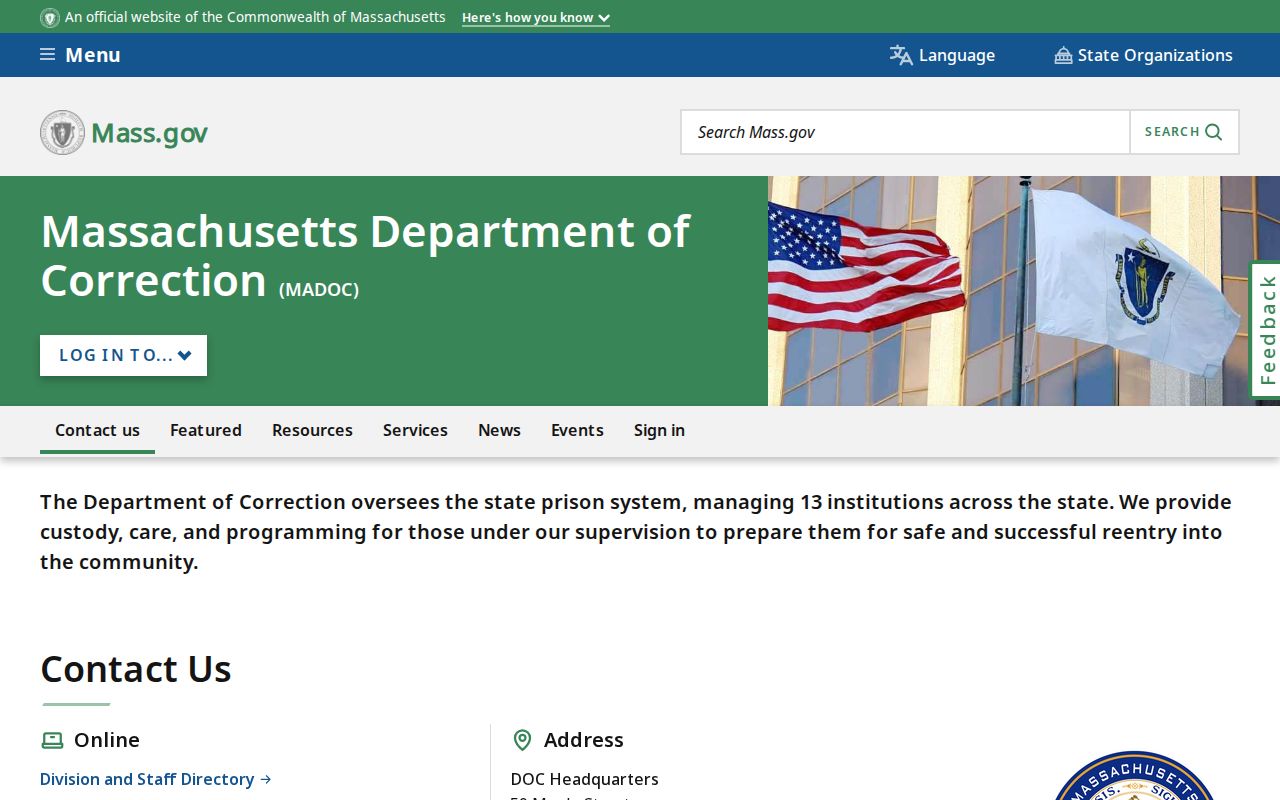
This agency page identifies the correct statewide custodian, but it does not replace a sheriff's record for a county-jail release.
Massachusetts Release Types and Destinations
MA DOC uses specific categories in its public reports. Their meaning prevents a common error: treating every release count as a count of people who walked out free of all custody. A community departure may include parole or discharge with probation still in force. A handoff can end one custody term while another begins. Court action may change a sentence or legal status without showing the minute a facility completed its exit process.
| Release type | What it means | Best record source |
|---|---|---|
| Parole supervision | Community release while the Parole Board keeps jurisdiction | MA DOC release record and Parole Board record |
| Without supervision | Discharge, sentence expiration, fine resolution, or good-conduct discharge without parole or probation | Custodian's release entry or discharge certificate |
| With supervision | DOC custody ends while probation continues | DOC record, court docket, and supervising court |
| Another justice agency | Transfer to federal, immigration, out-of-state, sheriff, warrant, or other custody | Movement record plus receiving-agency check |
| Remain incarcerated | A legal-status or sentence change occurs within custody | Sentence and movement records |
| County release | A police or sheriff custodian ends local detention | Local police, sheriff, and court records |
The MA DOC Admissions and Releases Types page publishes the terms used in statewide reporting.
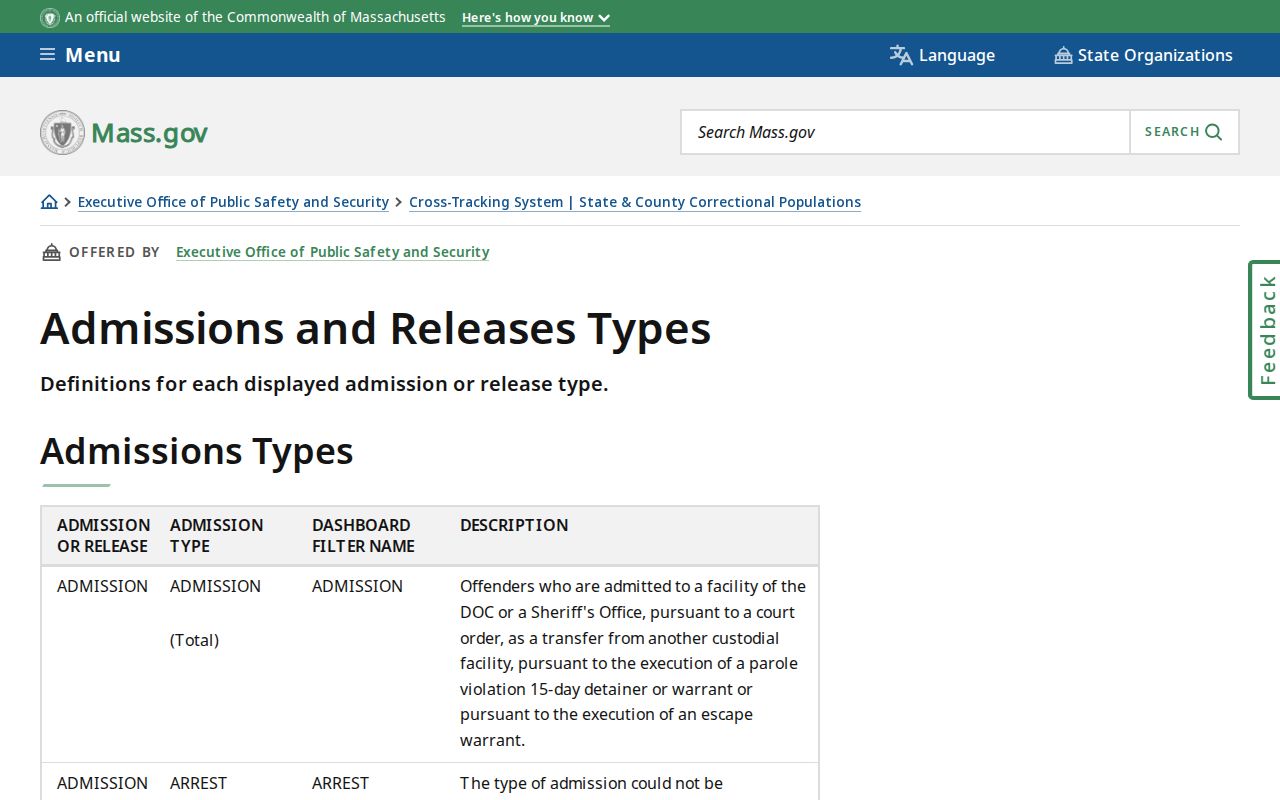
Read any Massachusetts release event beside its type and destination before drawing a conclusion about present custody.
Massachusetts Release Record Fields
No single statewide field set covers every sheriff and prison. Still, a focused request can seek existing fields that answer when custody ended, why it ended, and where the person went. County booking systems may use a booking number. MA DOC uses a commitment number. A court docket can show the order or disposition, yet it may not show when staff completed the physical release.
| Field to request | What it can establish |
|---|---|
| Full name and aliases | The identity used by the custodian |
| Booking or commitment number | The agency record tied to that custody period |
| Facility and custody dates | Where and when the agency held the person |
| Release date and time | When that custodian processed the departure, if recorded |
| Release type or reason | Parole, expiration, court action, bail, transfer, or another stated basis |
| Destination or receiving agency | Whether custody ended in the community or continued elsewhere |
| Release order or certificate | The source document authorizing release or confirming discharge |
| Supervision | Parole or probation noted after the custody event |
A live jail roster is not the historical release record. Likewise, the Massachusetts VINE path is not documented as retaining a released state prisoner's profile, status wording, release date, or a fixed retention period. When a past event matters, ask for the existing document by name rather than asking an agency to create a new report.
Request Massachusetts Release Records
Massachusetts Public Records Law gives the request route, but it does not make every correctional detail public. CORI restrictions, privacy or medical information, active investigations, victim information, and security procedures may support redaction or withholding. The records access officer should produce, permit inspection, or explain the response to a reasonably described request within ten business days, subject to lawful fees and extensions. Segregable, nonexempt parts should be produced.
- Identify the agency that held the person. Use the sheriff or police department for local custody, MA DOC for state prison, or the federal custodian for a federal matter.
- Give the full name, aliases, agency number if known, facility, and an approximate custody or release range.
- Name the existing record sought, such as a release sheet, movement entry, release order, sentence computation, or discharge certificate.
- Ask for the release type and destination when a transfer or detainer may have followed.
- Request an electronic copy and review any fee estimate or redaction explanation before narrowing the request if needed.
For state-prison records, the MA DOC public records page offers an online route, email to doc.rao@state.ma.us, and mail to the Primary RAO at 50 Maple Street, Milford, MA 01757. It lists 508-422-3436 and says the first four hours of response work are free, after which work may cost up to $25 per hour. MA DOC states that county jail and house-of-correction requests must go to the relevant sheriff.
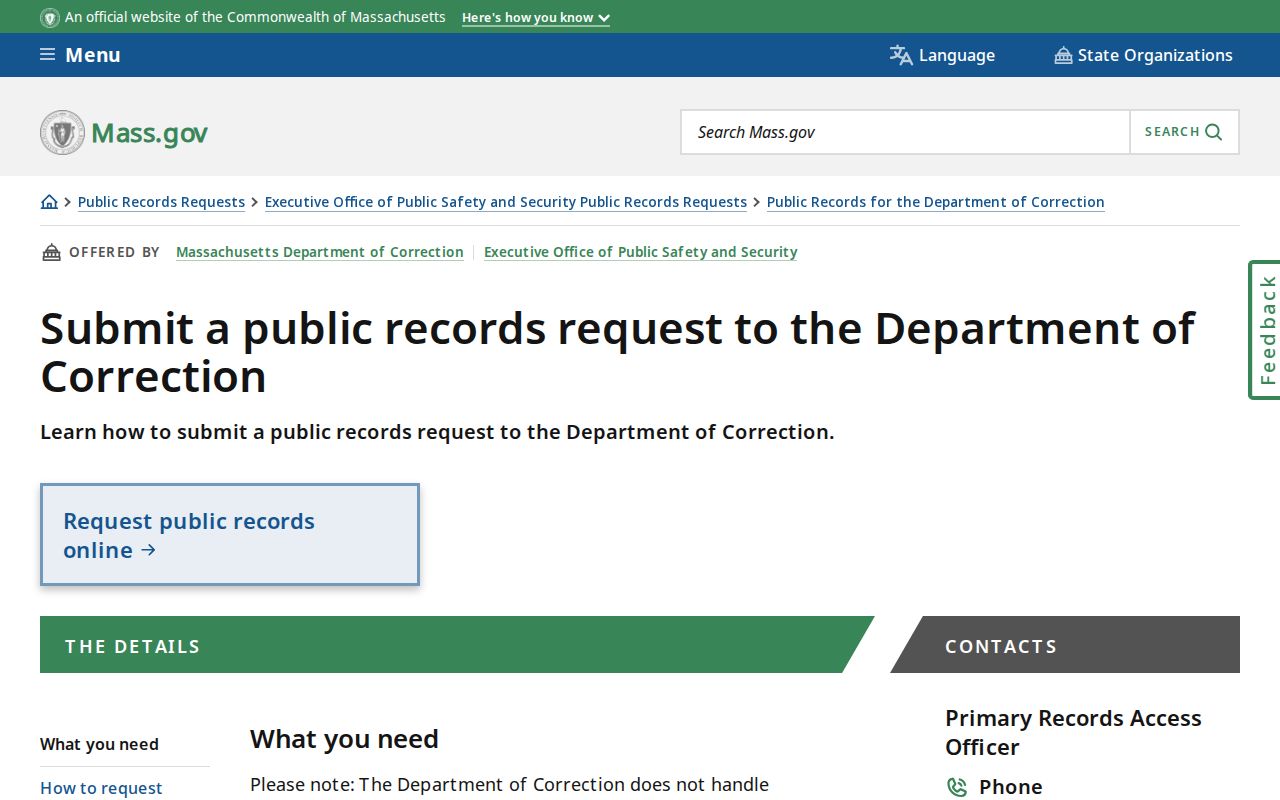
The official request screen is the documentary fallback when a present-custody search cannot confirm an old state-prison release.
Note: Disclosure is not assured, and an agency does not have to create a new compilation that it does not already keep.
Massachusetts Release Record Law
M.G.L. c. 66, § 10 controls the public-record request and response process. M.G.L. c. 4, § 7, clause 26 defines public records and their exemptions. Those laws support access to nonexempt existing records, not a promise that all booking photos, medical facts, security data, or CORI material must be disclosed.
Record boundary: A sealed or expunged matter, a juvenile record, protected CORI, or an exempt record may be unavailable or redacted. The facts and custodian decide the result.
Massachusetts research did not identify a special enacted law aimed at commercial mugshot publication or fees charged to remove a mugshot. Public Records Law, CORI rules, privacy and investigation exemptions, sealing or expungement, and court-access rules still may affect a particular image. None should be described as a universal removal right or a guarantee that every booking image is public.
Massachusetts Release Planning Stays Internal
MA DOC describes an Individual Reentry Plan that can address health coverage, community resources, care, medication, and appointments before a state-prison departure. In April 2026, the agency also announced an internal tablet tool built with Recidiviz. It lets an incarcerated person view anticipated release timing and plan for identification, benefits, and services. That tool is not a public locator. It does not create a public projected-release field for relatives, researchers, or other users.
Release-day details also vary by institution and case. The statewide research found no current official fixed gate-money amount. It did not establish one uniform time, exit, transport rule, property process, or pickup plan for all MA DOC releases. Ask the releasing institution when those details are needed. A planned date or ride does not prove that release occurred, while a completed release entry records the event after staff act.
The MA DOC release-planning announcement describes the internal anticipated-date tool and its planning role.
Note: Internal release planning can help the incarcerated person prepare, but public verification still depends on the proper agency record.
Find Massachusetts Released Inmates
Start with the last known custodian. That choice is more reliable than starting with a portal that looks statewide. Massachusetts VINE only includes MA DOC participation. It does not serve as a statewide archive of county-jail releases. The safest method checks both the end of one agency's custody and the possibility that another agency took custody next.
- For state prison, use the official MA DOC housed-person instructions and VINELink as a present-custody check. Search with the exact full first and last name or commitment number.
- For a sheriff jail or house of correction, identify the county and ask that sheriff for the booking, movement, or release record.
- For a police lockup, ask the arresting department and check the next court event. The person may never have entered a sheriff or DOC system.
- Use the court docket to test the disposition or order, but pair it with the custodian's record for the physical departure.
- For federal custody, use BOP. For present immigration detention, use ICE. Check each authority separately when a handoff is possible.
Important: No result in MA DOC or ICE does not prove release. It may reflect a transfer, a name mismatch, limited coverage, or another agency's custody.
The official MA DOC locator instructions describe a person currently housed or being held, not a historical released-person database.
The scope shown here is why a past release needs an MA DOC record, parole source, or court record instead of an inferred date.
MA DOC Massachusetts Custody Search
The MA DOC offender search label is useful shorthand, but Massachusetts officially calls its route “Find someone housed in a Massachusetts prison.” It sends users to VINELink. Enter a full first and last name or a commitment number, select Massachusetts, and compare the custody and facility details shown. The state also gives 866-277-7477 for help. Only MA DOC participates in the Massachusetts VINE program.
| Search input | Use and limit |
|---|---|
| Full first and last name | Search exact identity and compare possible matches with care |
| Commitment number | Use the MA DOC identifier when known |
| Custody and facility detail | Read only what the live result actually displays |
| No result | Do not convert absence into a release, discharge, or date |
The deeper MA DOC Offender Search page explains this narrow custody scope, MA DOC release categories, record requests, and state-prison release trends. It does not claim that VINELink displays a released profile, post-release status, or release date.
The VINELink portal is the service reached from the Commonwealth's locator instructions.
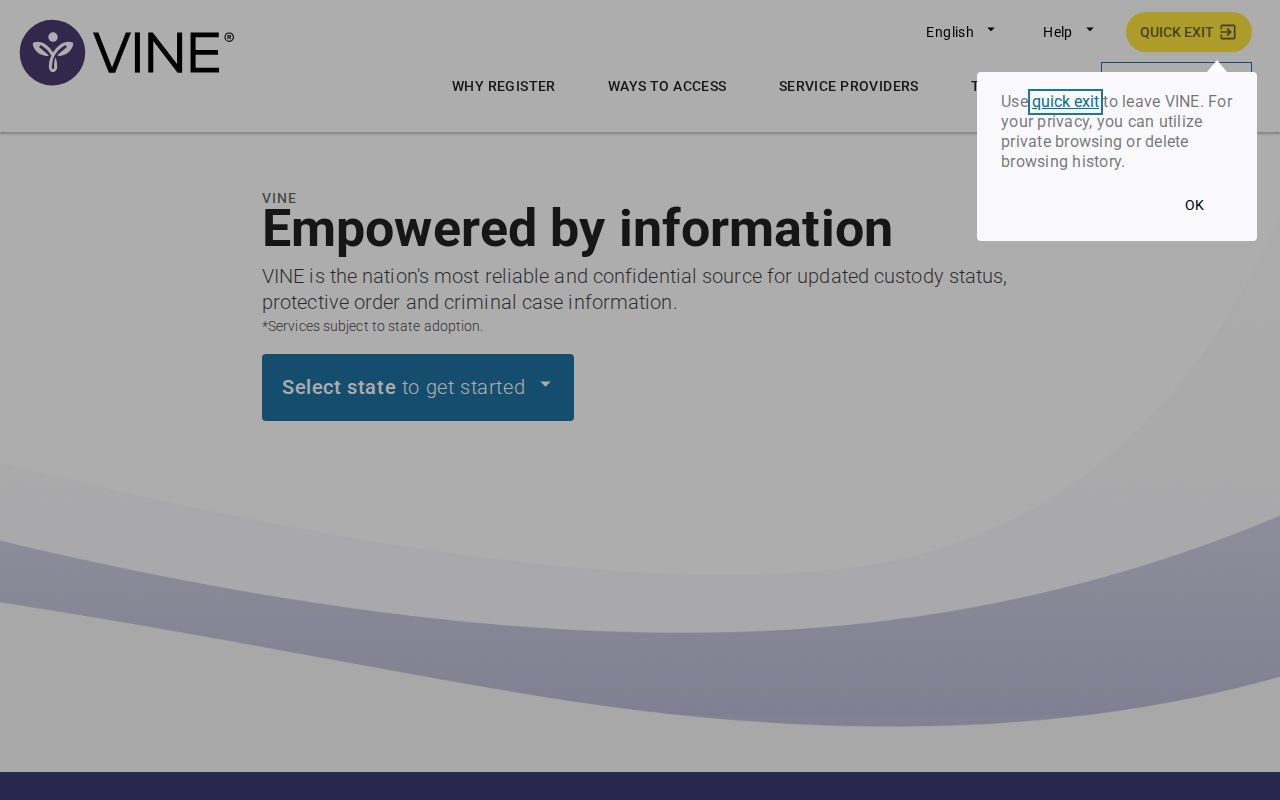
Its broad interface does not change Massachusetts' DOC-only participation limit or establish a county release archive.
Massachusetts County Release Routes Vary
Massachusetts has no single county-custody release feed. Research across all fourteen locality sites found sheriff record routes, live rosters without a historical view, regional placements, municipal lockups, and island transfers. A person can leave a police cell on station-house bail, go to court, enter a sheriff jail, or move to another custodian. The county where an arrest occurred may not be the place that holds the final release record.
Use the County Directory to identify the locality route, then confirm the actual custodian. A sheriff handles its jail and house-of-correction records. Police handle a municipal lockup event. MA DOC does not process county-jail requests. One building can also serve more than one authority, as Plymouth County Correctional Facility does in its county and ICE roles. A release from one legal authority can coexist with a transfer under another.
Massachusetts Releases Often Add Supervision
MA DOC's Prison Population Trends 2024 counted 1,223 releases. Of those, 442 went to parole only, 248 to probation only, 339 to both, and 194 to neither. That means 1,029 releases, or 84%, involved some form of supervision. The share rose from 74% in 2020 while the release count fell from 1,925 to 1,223.
Parole is conditional release under Board jurisdiction. Probation is court supervision and may continue after DOC custody ends. Massachusetts has no confirmed unrestricted name search for all current parolees or adult probationers. Use the Board or its regional office for parole, and use the sentencing court and its probation department for probation. An old parole decision does not prove present status.
The MA DOC releases dashboard provides dated statewide reporting views.
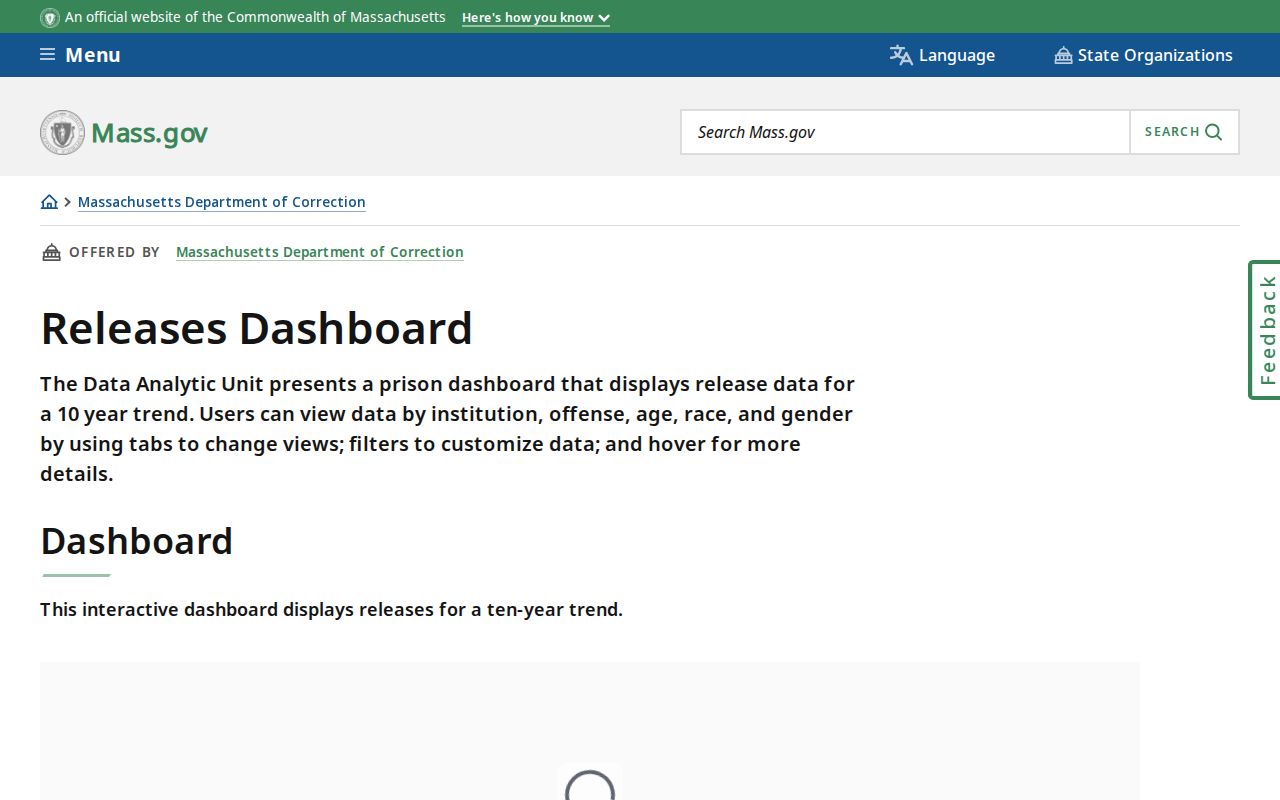
The dashboard reports populations and events, not a name search for one released person.
Massachusetts Discharge Certificates Matter
Leaving a facility and ending a sentence are distinct events. Under M.G.L. c. 127, § 129C and § 129D, qualifying deductions can establish the reduced maximum date and require a certificate of discharge. Under § 130A, the Parole Board may issue a certificate terminating a parolee's sentence when the statutory conditions are met.
- Release
- An agency ends a custody status; another custody or supervision status may follow.
- Discharge
- The relevant sentence or DOC jurisdiction ends as the record states.
- Parole
- Conditional community release while Board jurisdiction continues.
- Probation
- Court-ordered supervision, separate from DOC and parole.
- Detainer
- A request or legal basis that may lead to continued custody by another authority.
A release entry can prove departure from a named custodian. A discharge or termination certificate can answer the different question of whether that sentence or Board jurisdiction ended. Ask for the exact document that matches the fact being checked.
Massachusetts Court Release Cross-Check
MassCourts can show docket events, case disposition, and the court tied to probation. It should be treated as corroboration, not as the physical release log. Most Massachusetts criminal cases are remotely available only with the exact docket number. The clerk holds the official court record, and judicial records follow court access rules rather than the executive-agency request process.
After selecting the public-record route, choose the department, division, and location, then use the available case search tab. Compare the order or disposition with the jail, police, or DOC record. A judge's order may authorize release, while the custodian's entry records when processing occurred and whether another authority received the person.
The MassCourts portal is the statewide court interface used for this cross-check.
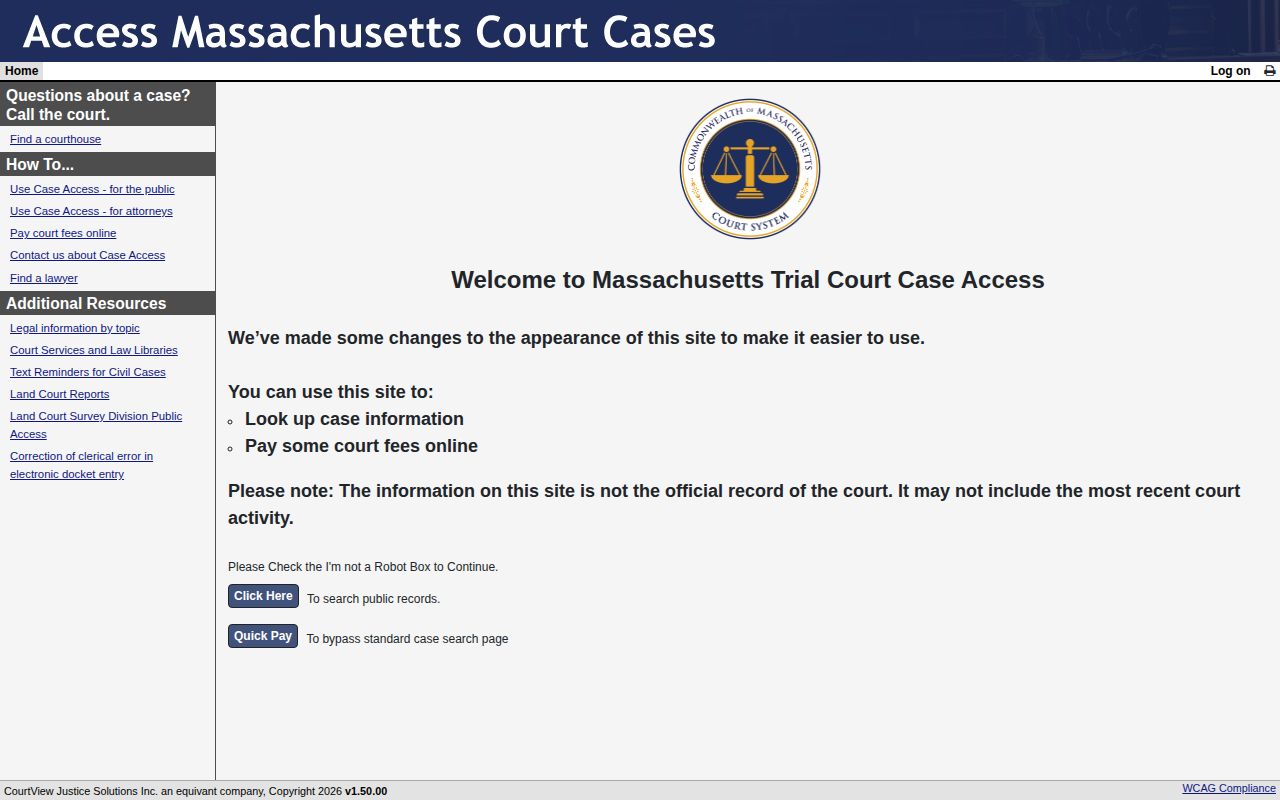
The portal is most useful when the docket number and court location are already known.
Massachusetts Federal Release Checks
Federal custody requires federal sources. The BOP Inmate Locator covers records from 1982 forward and accepts a BOP, DCDC, FBI, or INS number, or a name with optional narrowing. BOP defines “RELEASED” as no longer in BOP custody. When a past release date appears and no facility is listed, BOP says its custody ended on that date. Data update daily, and future dates can change. The result does not rule out another agency or later supervision.
The BOP Inmate Locator covers FMC Devens and other federal institutions.
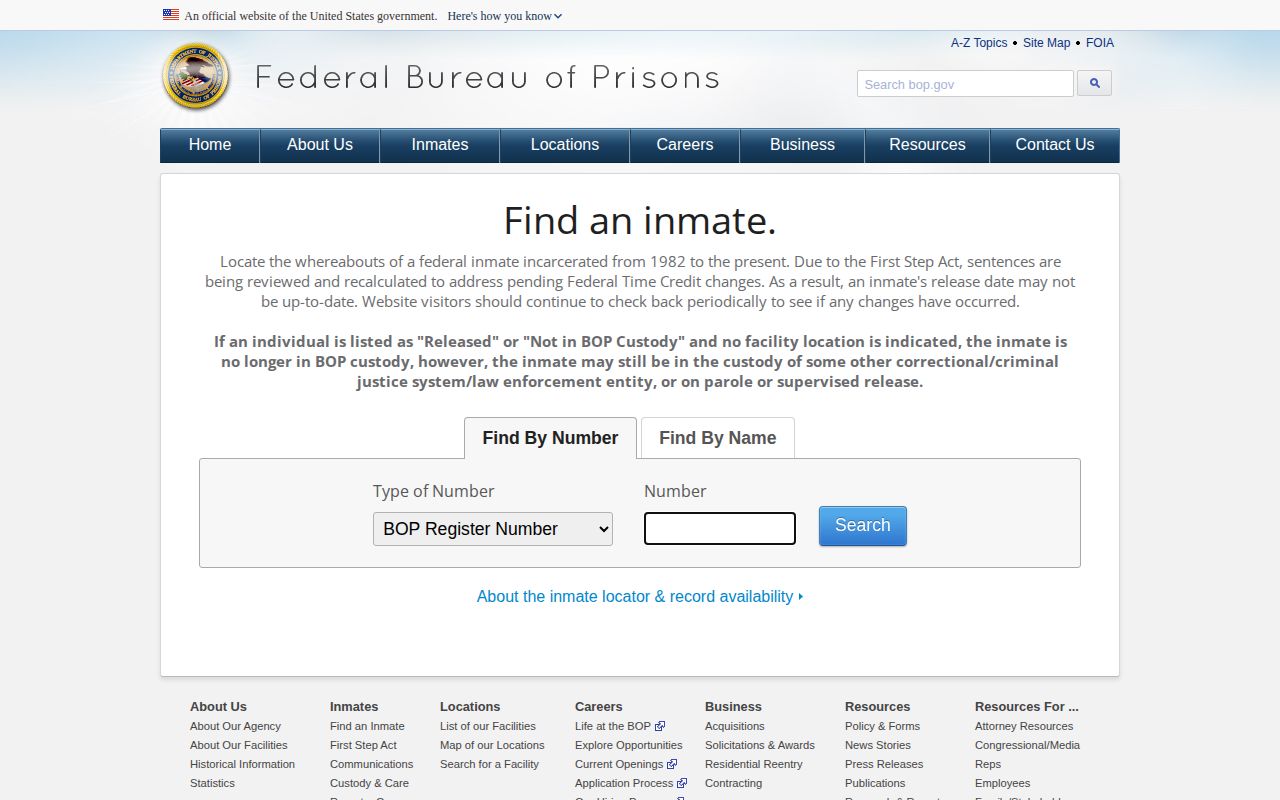
Unlike the MA DOC route, BOP documents past-release wording and a release-date interpretation for its own custody.
The ICE Online Detainee Locator checks present ICE custody or CBP custody beyond 48 hours. It is not a historical release archive. Search with a nine-digit A-number and country of birth, or exact name, country of birth, and optional birth date. A no-result can mean departure, transfer, processing delay, mismatch, age limits, or protected information. It cannot be labeled a release without another record.
Massachusetts Custody Source Comparison
Match the system to the last known legal authority. A current roster can show present custody, while a release or movement record documents a past event. Silence in a live tool is weaker than a dated source record.
| Custody layer | Present-status route | Past-release proof |
|---|---|---|
| Police lockup | Arresting department and next court event | Police custody or release record |
| County jail/HOC | Sheriff roster where available | Sheriff release, booking, or movement record |
| MA DOC prison | Official housed-person route through VINELink | DOC release order, entry, computation, or certificate |
| Federal BOP | BOP Inmate Locator | BOP released result and date, subject to its limits |
| ICE | ICE Online Detainee Locator | Historical agency or case record, not ODLS silence |
| Court | MassCourts with docket number when required | Clerk's official docket and order |
The statewide facility directory identifies the physical setting, but the legal custodian controls the record. A hospital, treatment unit, jail, or shared site may process a transfer rather than a community release.